Children & Youth Rights
Your rights as a Child or Youth
You are an important part of our Dnaagdawenmag Binnoojiiyag family. Your journey and your story matter to us! If you ever have something to tell us, we’re here to listen. Together, we can make things better. And if mistakes are made along the way (we are all human!), there are ways for you to hold us accountable. Our complaints process can be found here.
You have a lot of rights and it is so important that you know every single one of them.
Know Your Rights
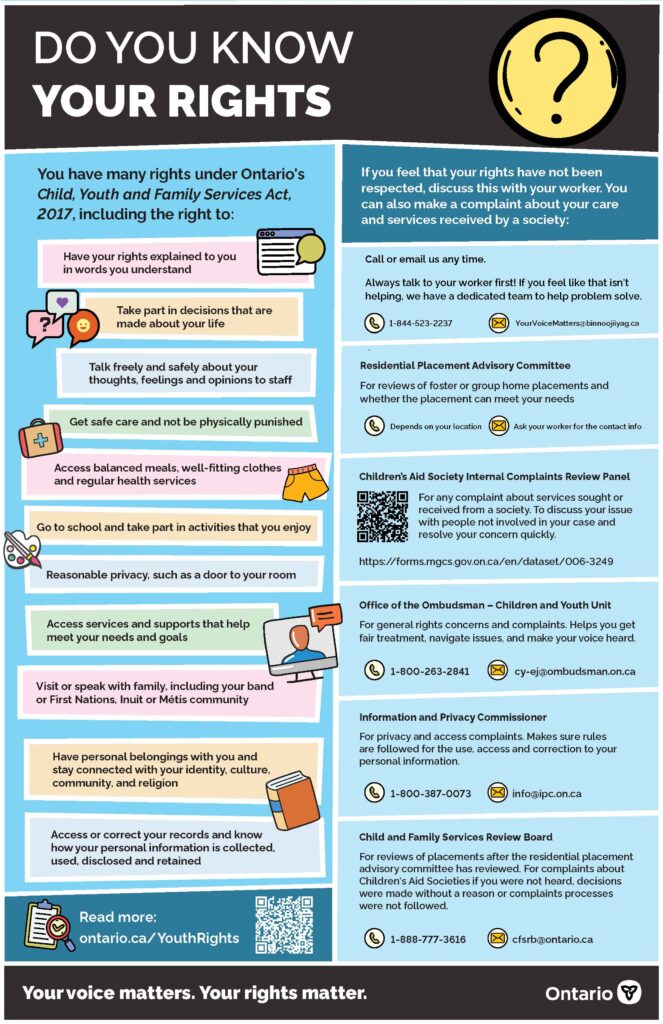
Right to know your rights and have them explained to you in a way you understand.
Right to share your thoughts and feelings safely about things that affect you.
Right to be heard and involved when important decisions are made about your life.
Right to know what is happening and be told things in a way you can understand.
Right to participate in your Place of Care and be part of decisions about services for you.
Right to speak up about concerns or ask for changes without being punished or treated unfairly.
Right to healthy food that fits your cultural, spiritual or health needs.
Right to be treated with respect, always.
Right to talk in private with people who support you.
Right to clothes that fit you and your activities.
Right to go to school and get support for your learning.
Right to take part in sports, fun and activities that make you happy.
Right to practice your spirituality, religion and beliefs.
Right to reasonable privacy and to keep your personal belongings safe.
Right to receive appropriate discipline and not be punished physically.
Right to not be locked up or restrained unless the law allows it for safety reasons.
Right to talk with and visit your family regularly. If there are times when you can’t visit your family, your Worker will explain why in a way that you understand.
Rights of an Indigenous Child or Youth
As an Indigenous person, you have special rights.
Right to identity, to know who you are and where you come from.
Right to know, learn and speak your language.
Right to traditional and contemporary healing that reinforces your identity and cultural pride.
Right to a good life.
Right to land or access to land.
Right to a lifestyle that offers opportunity for good health, prosperity and happiness.
Right to education that includes opportunities to learn experientially from Indigenous people as well as learning from books and formal institutions.
Right to your spirit name.
Right to know and be a member of your clan.
Your Responsibilities
You have some responsibilities which include:
I will follow the rules and expectations.
I will accept reasonable consequences if I break any rules.
I will respect other people’s privacy and belongings.
I will go to school and complete my homework.
I will take care of my personal hygiene.
I will work with my caregiver and worker respectfully.
If your Rights Aren’t Being Respected
Sometimes things may not go as you planned or had hoped. If that happens, you should always talk to your worker. Let them know how you are feeling. If you feel like you can’t talk to your worker or you’ve tried and nothing changed, we are very sorry. We want you to feel heard, supported and respected.
That’s why we have a special process just for you!
Raise your voice by:
- Talking to your worker
- Talking to another staff person or adult in your life
- Write down your thoughts and send them to us by email
- We will document your feedback to make sure we understand.
- We will respond within 1 business day
- We will examine the facts within 2 business days. We will keep you included in this process unless it’s in your best interest not to.
- If your rights have been disrespected than we may need to involve others. You may also wish to seek help from a lawyer or the Ombudsman.
- We will share updates with you every 15 days until the review is complete. Then, we will discuss the outcome and if anything needs to be fixed.
- We will debrief with everyone involved within 7 days.
- We will review this process each year to make it better. We would love to hear your suggestions!
You can also email us directly at YourVoiceMatters@binnoojiiyag.ca
Other Options
ONTARIO OMBUDSMAN
- You have the right to contact the Ombudsman if you feel you are not being treated fairly or respectfully.
- The Ontario Ombudsman’s Office investigates complaints about government and public services, including complaints about services received from a Child and Family Well-Being Agency. Their job is to make sure children and youth are treated fairly and with respect.
- They can help if you have worries about your care, your caregiver, school, being in custody/detention, or any other public services you receive.
How to contact them:
- Phone (free in Ontario): 1-800-263-1830
- Phone (outside Ontario): 416-586-3300
- Email: info@ombudsman.on.ca
- Website: ombudsman.on.ca
CHILD AND FAMILY SERVICES REVIEW BOARD
- The CFSRB is an independent tribunal that is responsible for conducting reviews and hearings for matters that affect children, youth, and families
- You have the right to make a complaint to the CFSRB at any time regarding concerns about services you have received from the Agency.
- They will look at your concerns and decide what should happen next.
How to contact them:
- Phone: 1-888-777-3616
- Email: cfsrb@ontario.ca
- Website: tribunalsontario.ca/cfsrb